Pathless vs Pathful Motion

Table of Contents
Chapter 1b explained that:
- the natural or aethereal universe is flexible and subjective
- the artificial or material universe is rigid and objective
This gives us 2 kinds of changes:
- Arbitary Change
An example is a buffet where you can choose whatever dish you like. This leads to non-determinsm.
- Non-arbitrary Change
An example is a la carte dining where you have a fixed course of dishes in a sequence. This leads to determinism.
This also gives us 2 motions:
- Pathless Motion
This is where you can be at one location and then in another location instantly. This is called non-local motion and is seen in dreams and in UFOs that teleport. This is a focus on Superphysics, whether as:
- teleportation technology in Material Superphysics, or
- the rapid transformation into new realities in Social Superphysics
- speedier healing in Bio Superphysics
- better chance at samadhi in Spiritual Superphysics
- Pathful Motion
This is sequential or local motion and is seen in:
- Differential geometry in Modern Physics
- public infrastructure as roads and bridges
- weight loss programs that gradually change your weight and health
- rehabilitation programs to get rid of addiction
Pathless Non-Locality from the Independence of the Spacetime Slices
Pathless motion is possible because the slices of spacetime are independent of each other, just as a node is its own thing and not an effect of the previous nodes.
The real mechanism that converts a wave into a node is the Negative Force, just as the mechanism that converts a node into a wave (by removing agitation in order to flatten Existence) is the Positive Force.
This is because nodes emerge from waves just as bubbles emerge from splashing water. In contrast, a smooth flow creates no bubbles. People who overthink have a lot of mental agitation.
The spacetime slices are usually related to each other just as the crest of a wave is related to its trough.
Similarly, a universe is independent of other universes.
However, what happens in another universe has a relation to other universes and can affect others.
This independence leads to the concept of non-locality in Quantum Mechanics.
The Wave-Nature of Reality means that one timespan or moment is connected to another timespan.
The connection of these lead to the concept of time.
But each of these timespans is really caused by 2 perceptions. The gap between these 2 perceptions is what we call timespan.
This means that timespan and time are effects of perception.
But perception is merely a disturbance in the pure aether substance which is totally independent of other disturbances.
This means that each perception is independent.
Therefore time and timespan are dependent on the current perception.
The error is that people think that the current perception is dependent on the past, just as the future is dependent on the present.
Monty Hall Fallacy
The same fallacy of treating events as not independent (as if there were a true starting point) afflicts the Monty Hall Problem.
The Monty Hall problem says that there are 3 doors.
- One door has a prize.
- Two doors have nothing.
- You choose door 1.
- The host removes Door 2 which has nothing.
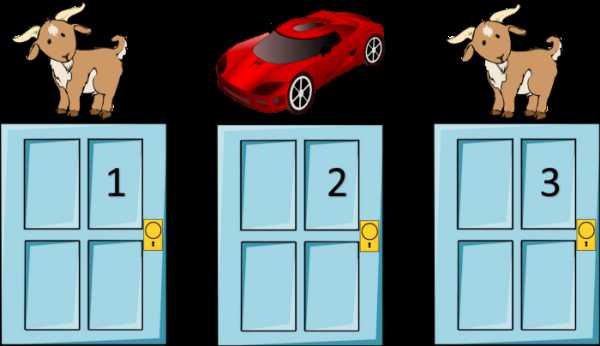
‘Smart’ people say to choose the other door because the odds have risen from 1/3 to 2/3.
This is because they see reality as one continuity, instead of being independent of each other.
But in the natural way of thinking, with each spacetime slice being independent and having equal value to other slices, then the probability is 50/50.
This is because 2 is even or symmetric. The host converts the unsymmetric 3 into a symmetric 2.
Nonsymmetric Temporal Logic
The defenders of the Monty Hall fallacy defend their logic by expanding the scenario to 9 doors.
- After you choose a door, the host opens the 8 other doors to leave only 2 doors unopened: your current choice and another door.
- And so you must choose that other door since that rises to 89% chance of having the prize
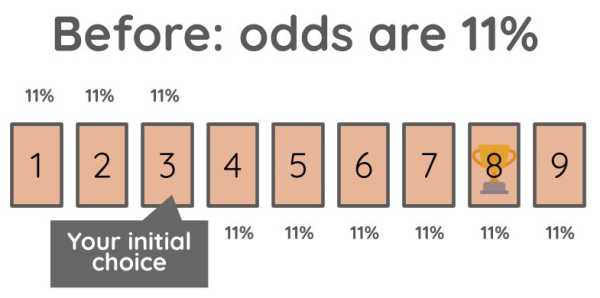
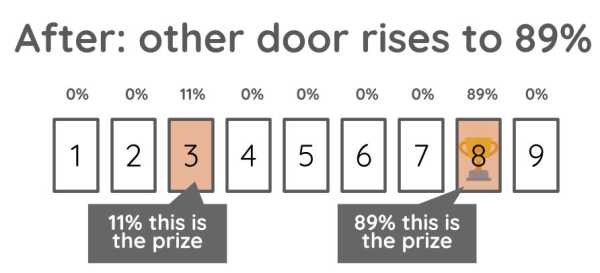
But the error in this reasoning is that it is comparing symmetric apples to unsymmetric oranges.
Host Knows The Prize: Sequential Opening 1 at a time
By removing each door sequentially, the problem shifts from being an issue with space symmetry or unsymmetry, into the temporal journey to the truth, as the prize.
At 9 doors unopened, the probability is:
- 1/9 or 11.11% that you chose the prize
- 8/9 or 88.89% that the prize is elsewhere
At 8 doors unopened, the probability is STILL:
- 1/9 or 11.11% that you chose the prize
- 8/9 or 88.89% that the prize is elsewhere
This means that when 2 doors are left, then it means that:
- 1/9 or 11.11% that you chose the prize
- 8/9 or 88.89% that the prize is in the other door
| Unopened doors | Your choice has prize | Prize is elsewhere |
|---|---|---|
| 9 | 11.11% | 88.89% |
| 8 | 11.11% | 88.89% |
| 7 | 11.11% | 88.89% |
| 6 | 11.11% | 88.89% |
| 5 | 11.11% | 88.89% |
| 4 | 11.11% | 88.89% |
| 3 | 11.11% | 88.89% |
| 2 | 11.11% | 88.89% |
Host Doesn’t Know The Prize: Sequential Opening 2 at a time
This is different when you and the host BOTH do not know where the prize is.
At 9 doors unopened, the probability is:
- 1/9 or 11.11% that you chose the correct door
- 1/9 or 11.11% that the hose chose the correct door
If you both open a door so that 7 doors are left, and no prize was hit, then the probabilities change:
- 1/7 or 14.29% that you chose the correct door
- 1/7 or 14.29% that the host chose the correct door
In the end, if no prizes are still arrived at, this will lead to 3 doors, and a 1/3 chance for each door.
Notice how the probability ratios change just because the host was ignorant.
| Unopened doors | Your choice has prize | Host Choice has prize |
|---|---|---|
| 9 | 11.11% | 11.11% |
| 7 | 14.29% | 14.29% |
| 5 | 20% | 20% |
| 3 | 33.33% | 33.33% |
Spatial Logic: Symmetry and Unsymmetry
A proper extension of the 3 door scenario to 9 doors is for the host to open 3 contiguous doors. This will leave 6 doors unopened.
For example, assume the prize is at door 5, and I choose door 7.
- The host opens doors 1, 2, 3 to reveal no prize.
- This leaves two 3-door groups: 4-5-6 and 7-8-9
- This leads to the same outcome as the original 3 door scenario with the doors being split into groups of 3-doors each.
- The winner would win if he chooses the correct 3-door group
This will lead to the symmetric chose of 2 groups of 3 doors each – the odds in the 3 door scenario ended up as 50-50.
Host Knows The Prize: Non-Sequential Opening Groups of 3
| Unopened doors | Your choice has prize | Prize is elsewhere |
|---|---|---|
| 9 | 33.33% | 66.67 |
| 6 | 50% | 50% |
Different Conditions, Different Outcomes
As you can see, the differences in conditions change very much the probabilities.
A sequential opening can lead to a gradual, predictable change in probabilties.
But a single spatial opening can lead to a fixed probabiltiy