Pointization

Table of Contents
The previous section explained how points-valuation works by converting the money-price of things into a points-price.
Points facilitate economic democracy by pegging value to the retail price of grains.
However, this creates short term, small-scale volatility since grain prices can change daily, but in small amounts.
In contrast, interest rates, which set the value of money, can be pegged to a certain rate for a long time.
The supporters of the money system try to solve poverty through 2 systems that use money:
- Universal Basic Income (UBI)
Studies have shown that this is not sustainable, as proven by UBI projects being stopped.
- Microfinance
Cambodia and India have shown that microfinance does not solve structural problems that cause poverty and so they end up worsening the lives of the poor through debt traps.
This is further explained in Chapter 9.
Pointization Solution
Instead of money based solutions to poverty, Supereconomics introduces bilaeral points, as barter credits.
These points are created whenever there is an agreement by two parties.
- This agreement is an effect of fellow-feeling.
For example, John can give his harvest of 1 kilogram of potatoes to Martha in exchange for 2 points (assuming that 1 kilogram of potatoes is worth 2 kilograms of wheat).
- John will then have a right to claim those 2 points as whatever Martha is producing.
- If she is a baker, then John can claim bread worth 2 points from her in the future.
Thus, the points are not created by any bank, but by the people themselves judging the value of the goods and services of others relative to themselves and others.
The points can only be created and destroyed as deposits and claims, similar to tags in a baggage counter.
As such, the points are not exchangeable and are not legal tender.
So far, only the take tags * of the Resource Based Economy (RBE) has a similar yet rudimentary idea of this.
Superphysics Note
This service provides the following advantages:
- Like UBI, it mobilizes productivity by letting people feed each other with points
- Like conditional cash transfers, it imposes conditions between people based on their agreements
- Like Microfinance, the points can be claimed regularly to see which point-producers are actually productive and reliable
When viewed on a macro level, the points-deposits represent an estimate of future productivity.
This is different from money-deposits which represent actual productivity. Money-deposits are governed by interest rates as the ’time value of money’, but points-deposits are governed by the moral sentiments* of the exchangers.
Superphysics Note
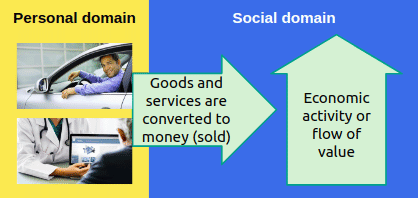
- ‘Monetization’ speeds up an economy by converting goods and services into money through sales
- ‘Pointization’ is the opposite conversion of money into a promise of future resources.
Pointization thus saves companies and societies from a monetary crash, by facilitating a soft-landing.