The Metaphysics of Value

Principles
| Principles | Assertions |
|---|---|
| Value is subjectivized desire, Prices are objectivized desire | The desires in the physical domain follow the 4 Laws of Thermodynamics |
| . | The desires in the economic domain follow the 4 Laws of Exchangeable Value |
I shall explain [exchangable value] as fully as I can. I earnestly hopefor the reader’s patience to examine something tedious, and his attention to understand what may still be obscure after the fullest explication.

Adam Smith
Book 1, Chapter 3 of The Wealth of Nations Simplified
The previous chapter explained the concepts of:
- the society organism made up of individual souls bound by relationality
- the collective wave of human desire
Thus, Supereconomics really deals with the waves of desire both of supplier and demander, and how to satisfy both with each other.
This wave of desire creates the concept of value (from Latin valere or worth), which we define as the importance or matching impact of something to a mind, based on desire.
Constructive Versus Destructive Interference
This worth is the ability of something to match the vibration or fill the void created by the desire. This would then satisfy or calm down or flatten that wave.
This satisfaction can be in the form of usefulness & pleasure, or as the reduction pain & stress.
We say that:
- the satisfaction or quelling of that desire is destructive interference
- the building or increase of that desire is constructive interference

Therefore, we can say that:
- advertising and marketing try to create constructive interference to build up an existing or latent desire
- sales and purchasing try to create destructive interference to quell the current desire
Value versus Price, Subjective versus Objective
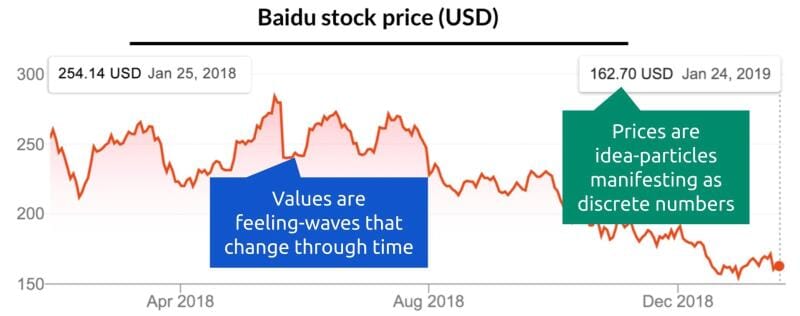
Since value is a vibration, then it always changes. This perpetual change makes it subjective.
For example:
- Yesterday, I might have wanted chocolate (sweet)
- Today, I might want ice cream (creamy)
- Tomorrow, I might want potato chips (salty)
The lack of specific values that can be compared with other values makes it difficult to find quantitative relations between the qualities of sweet chocolate, creamy ice cream, and salty potato chips.
This then makes supplying these desires difficult and inefficient.
To create more efficiency in supply and demand, values are objectified into prices as a discrete number.
- ‘Value’ can be imagined as a fluffy cloud with no specific boundaries, or as water in a stream that isn’t contained as a single object
- ‘Price’ can be imagined as a cotton ball that has been compressed as to give it a specific shape, or as a water in a glass that has a specific measure, such as 100mL
Value thus has the same dynamics as inexact fluctuating waves, while price has the dynamics of exact fixed particles. Value is more fundamental* than prices just as waves are more fundamental than particles.
If value were a moving desire-entity, then price would be a snapshot of that desire taken at a certain time.

We can say that value is the cause, and price is just the effect (Socrates calls them shadows).
You can hand out prizes such as trophies, but not the value that they represent such as being brightest in class. It is possible to buy an award, yet not be worthy of it.
The objectification of value into price thus makes value flow more easily between people at the cost of losing some of the essence or truth of that value.
- But this untruth or discrepancy is exactly what allows profits as secondary arbitrage.
Supereconomics aims to reduce those untruths through the concept of relationality as vibrational matching through grain-based valuation.
Economics is full of specific numbers as GDP, population size, unemployment rate, trade deficit, etc, but only has a few concepts of abstract value.
For example, the economic value of a bridge is more abstract than its cost-price.
- Its economic value has a range such as $1b-$1.5b over 10 years. This is a “fluffy” prediction.
- Its cost price is a specific number such as $100m, paid in 2010. This is exact down to cents, if the accountant is diligent enough.
The 4 Laws of Exchangeable Value
The engine of value is desire.
- Western philosophies, such as liberalism, utilitarianism, and objectivism, teach the pursuit of desire
- Asian philosophies, such as Buddhism, Hinduism, and Taoism, teach the renunciation and control of desire
This desire is a product of the mind and thus exists in the metaphysical dimension. Its physical counterpart is physical energy as heat, calories, joules, etc.
The rules for physical energy are described as the Four Laws of Thermodynamics. We carry over these laws onto Supereconomics as the Four Laws of Value which operate on human desire*.
Thus:
- the metaphysical dimension has desire, with its dynamics explained by the four laws of value
- the physical dimension has energy, with its dynamics explained by the four laws of themodynamics
The Celsius degrees in thermodynamics then manifest as currency prices in Supereconomics. This lets us fit all the principles of Supereconomics elegantly under the four headings of the 4 Laws of Value.
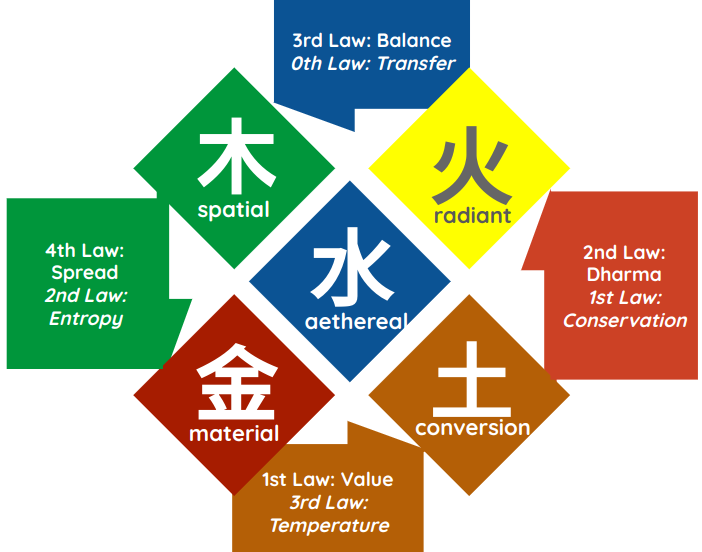
This classification is different from the messy* organization of Economics as micro-macro-economics, behavioral, political economy, development economics, etc.
*Such a mess is what happens when people build something in an uncoordinated way or without looking at the very big picture. In contrast, our Supereconomics is a subset of Social Superphysics which is itself a subset of Superphysics.
Before we explain the four laws of value, we have to explain the different kinds of value.