Socrates: Parmenides
Table of Contents
1 Socrates was the son of Sophroniscus, a statuary, and of Phænarete, a midwife; as Plato records in his Theætetus, he was a citizen of Athens, of the borough of Alopece.
2 Some people believed that he assisted Euripides in his poems; in reference to which idea, Mnesimachus speaks as follows:
The Phrygians are a new play of Euripides,
But Socrates has laid the main foundation.[19]
And again he says:—
Euripides: patched up by Socrates.
Callias, in his Captives, says:—
A. Are you so proud, giving yourself such airs? B. And well I may, for Socrates is the cause.
Aristophanes says, in his Clouds:
This is Euripides, who doth compose Those argumentative wise tragedies.
3 Some people say Socrates was a pupil of Anaxagoras.
Alexander in his Successions says that he was a pupil of Damon.
After the condemnation of Anaxagoras, he became a disciple of Archelaus, the natural philosopher.
Aristoxenus says that he was very intimate with him.
4 But Duris says that he was a slave, and employed in carving stones.
Some say that the Graces in the Acropolis are his work; and they are clothed figures.
Timon wrote in his Silli:
From them proceeded the stone polisher, The reasoning legislator, the enchanter Of all the Greeks, making them subtle arguers, A cunning pedant, a shrewd Attic quibbler.
5 Idomeneus says that Socrates was very clever in all rhetorical exercises.
Xenophon tells us that the 30 tyrants forbade him to give lessons in the art of speaking and arguing.
Aristophanes in his Comedies turns him into ridicule, as making the worse reason appear the better.
Phavorinus says in his Universal History, that he was the first man who, in conjunction with his disciple Æschines, taught men how to become orators.
Idomeneus makes the same assertion in his essay on the Socratic School.
Socrates, likewise, was:
- the first person who conversed about human life
- the first philosopher to be condemned to death and executed
Aristoxenus, the son of Spintharas, says that he:
- lent money in usury
- collected the interest and principal together, and then, when he had got the interest, he lent it out again.
Demetrius, of Byzantium, says that it was Criton who made him leave his workshop and instruct men, out of Criton’s admiration for his abilities.
6 He saw that natural philosophy was not interesting to people. So he began to enter moral speculations, both in his workshop and in the market-place.
And he said that the objects of his search were whatever good or harm can man befall In his own house.
Very often, while arguing and discussing points that arose, he was treated with great violence and beaten, and pulled about, and laughed at and ridiculed by the multitude.
But he bore all this with great equanimity.
Demetrius says that once, when he had been kicked and buffeted about, and had borne it all patiently, and someone expressed his surprise:
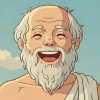
Suppose an ass had kicked me, would you have had me bring an action against him?
7 But he had no need of travelling (though most philosophers did travel), except when he was bound to serve in the army.
But the rest of his life, he remained in the same place.
In an argumentative spirit, he used to dispute with all who would converse with him, not for educating them, but for learning the truth from them for himself.
They say that Euripides gave him a small work of Heraclitus to read and asked him what he thought of it.
I think what I have understood is good. For things that I have not understood, these require a Delian diver to find their meaning.
He paid great attention also to the training of the body, and was always in excellent condition himself.
Accordingly, he joined in the expedition to Amphipolis.
He took up and saved Xenophon in the battle of Delium, when he had fallen from his horse.
For when all the Athenians had fled, he retreated quietly, turning round slowly, and watching to repel any one who attacked him.
He also joined in the expedition to Potidæa, which was undertaken by sea for it was impossible to get there by land, as the war impeded the communication.
They say that he remained the whole night in one place.
He had deserved the prize of pre-eminent valour, yet he yielded it to Alcibiades.
Aristippus in book 4 of his treatise on the Luxury of the Ancients says that Socrates was greatly attached to Alcibiades.
But Ion, of Chios, says that while he was a very young man he left Athens and went to Samos with Archelaus.
Aristotle says that he went to Delphi.
Phavorinus also, in book 1 of his Commentaries, says that he went to the Isthmus.