Normal Force

Table of Contents
This is the contact force exerted by a surface perpendicular (normal) to an object resting on it, counteracting its weight (e.g., a table supporting a book).
This happens from the 1st Rule of Motion as Nature not having any voids.
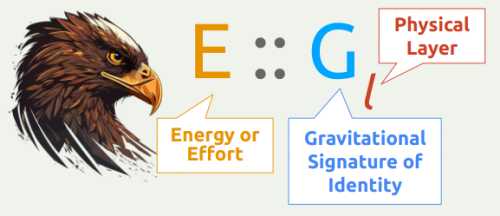
In Part 1, we explained action-at-a-distance using aethereal effort, as the Eagle, and Cartesian Relationality.
In Part 2, we explained 2-dimensional space-time slices are stitched together by the mind to create a 3-dimensional reality.
Here, we apply those concepts to explain and convert Newtonian contact forces into the Material Superphysics paradigm.
According to Newton’s Second Law, net force equals mass times acceleration. This assumes an absolute space.
In Material Superphysics:
- Newton’s Second Law is absorbed into the 3rd Rule of Motion of Descartes-Spinoza.
- relational spacetime slices are used instead of absolute space. This is similar to Mach’s Principle.
So we apply our eagle to the problem below.
A box is pushed with an initial speed of 4.2 m/s. The friction is 0.18. How far will the box go?
acceleration :: -0.18 * 9.81 m/s
The force of friction is 1.764 m/s2
0 = (4.2)^2 + 2(-1.764) d
The Newtonian system gives a distance is 5 meters.
Cartesian Relationality
We next use the same data for Cartesian Relationality.
0E Block : 5m : 1E Block
We put:
- the intial force to the 1E variable
- the friction force to the 1st block
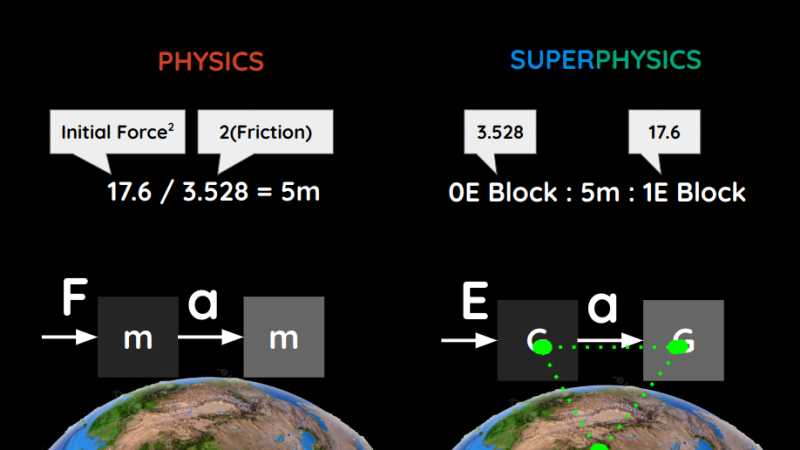
This gives us the same result as F = m a
The main difference is that this new version splits the identity of the object into two or more different objects. The block at time 2 location 2 is different from the same block at time 1 location 1 in the sense that it has absorbed force and changed its locational attributes.
Newton’s laws, however, see the object as the same object. This limits it to linear, forced movements.
This will then be useful for teleportation by a change in spin*.