
Table of Contents
The Economist showed an interesting graphic of the correlation of skyscrapers and economic crises in a phenomenon known as the Skyscraper Curse.
A question was posed: “Does this frenzy of building augur badly for the world economy?”, to which we answer “Yes, because of Economics”.
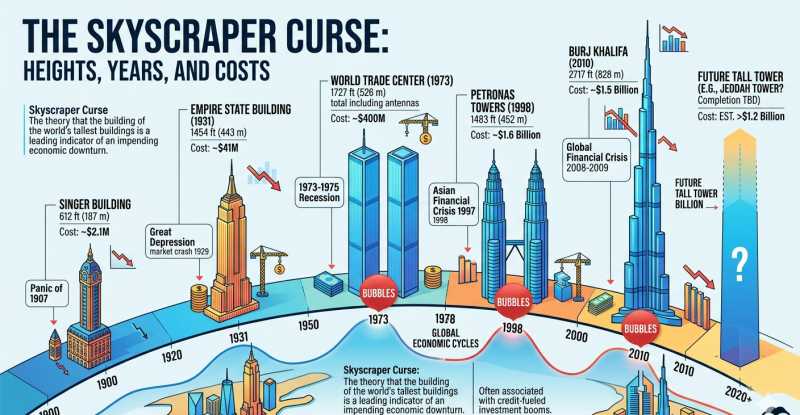
In Supereconomics, the curse is a violation of the Third Law of Value.
To explain it, we need to explain the natuare of skyscrapers and the real value of real estate.
What is the basic nature of skyscrapers?
Skyscrapers are concrete floors stacked on top of each other to create vertical space for humans to stay in while doing limited residential, office, or commercial tasks. Human activity is limited in them because they cannot support too much weight or movement, unlike factories or stadiums.
Their height is the effect of high quality of space, as expensive land prices, and the high quantity of demanders for that space, as population density.
- Calcutta has among the most demanders of space (at 24k per square km) but has low quality space
- Hongkong has both many demanders (at 57k per square km) and high quality spaces, from its economic strength
Thus, Calcutta has few tall buildings, while Hongkong has many.

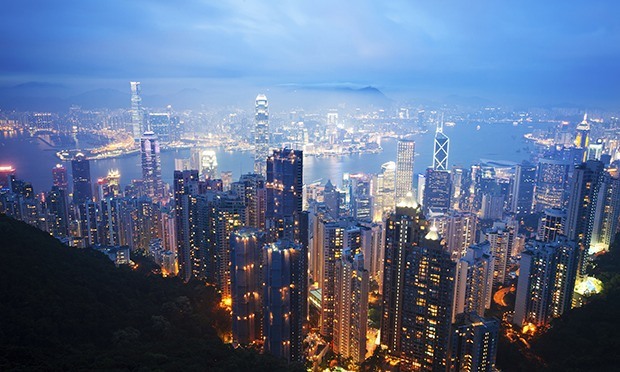
Skyscrapers are the manifestation of the engrossment of nominal capital, created by profit maximization
Skyscraper construction needs a lot of nominal capital* as money, which is used to mobilize work to convert ore and rock into real capital, such as steel and concrete. Raising this nominal capital is done by financiers by pooling money from various sources.
As a financial hub, Hongkong has a lot of money flowing through it and has no problem pooling money to build tall structures sustainably.
Update May 2026: This was also done by Dubai as it transitioned from oil exporter to financial hub where rich people park their money.
The Force of Capital
Adam Smith said that money is dead stock – you need to spend it for it to get value.
Every unnecessary accumulation of money is a dead stock which could be employed in enriching the nation by foreign commerce.

Having a lot of money therefore adds pressure to spend it. We call this the force of capital.
This force is not confined to money, since we define capital as anything that creates value.
Capital can be a beautiful face, a great voice, tall athletic height, etc.
People with such capital have a natural pressure to use their advantages.
- Some beautiful people go to showbiz only to get burned by gossip and controversy.
- Some atheletes join professional sports only to get injuries and are forced to quit
Likewise, rich people are forced to invest their money.
The Danger of Having too Much Capital
This unnatural volume of money, together with the pressure to spend it, leads to its own destruction through:
- overtrading
- a gradual reduction of real capital via recessions
The monied people think of the best ways of spending that will match the volume of money that they have. This leads to vanity projects that appeal to other monied people.
The high rate of profit seems every where to destroy that parsimony natural to the character of the merchant.When profits are high, parsimony seems unsuitable to the affluence of his situation. But the owners of the great mercantile capitals are the leaders and conductors of the industry of every nation.. if the master is dissolute and disorderly, the servant will follow his master’s example..
Over-trading is the common cause of it. Sober men, whose projects cost more than their capitals, will likely have no means to buy money nor credit to borrow it. They are like prodigals whose expence has exceeded to their revenue. Before their projects can be brought to bear, their stock is gone, and their credit with it.
Socrates supports this:
But there are two causes of the deterioration of the arts: Wealth and Poverty. When a potter becomes rich he will.. grow more and more indolent and careless, and become a worse potter. But, on the other hand, if he has no money.. he will not work equally well himself. Then, under the influence either of poverty or of wealth, workers can degenerate. Here, then, is a discovery of new evils of wealth and poverty, against which the guardians will have to watch, or they will creep into the city unobserved.

Thus, high profits opens up the desires of the ego and the imagination, manifesting a ‘irrational behaviour’.
Globalized Nominal Capital, Globalized Crises
Because of globalization, this nominal capital was able to flow outside of the US and Europe, where the demanders of space has been declining, into Asia and the Middle East where there has always been many demanders. Just as what happened during the 1907 Panic, Great Depression, and Oil shock in the West, the engrossment nominal capital has also caused the same effects in the East: overtrading and skyscrapers, among others.
Skyscraper booms are therefore an indicator of the engrossment of nominal capital into some fund which, when integrated with the profit maximization doctrine of business and economic sciences, must eventually create some kind of bubble or economic crisis.
Usually, the crash of nominal capital happens first, followed by a crash in real capital.
In other words, a recession hits first or the bubble bursts before the skyscraper/s or huge projects are finished, simply because it is quicker to move money around than to convert rock and ore into a tall building. In fact, this graphic by the Economist fits very well with our prediction of a global stagflation hitting before 2020*.
May 2020
By extending the relationship between crisis and skyscrapers, we add into our predictions that this new crisis will hit before the Kingdom Tower will be built in November 2019. As the root cause of all of these is high profits, the inevitability of this crisis can be attributed to the profit maximization doctrine, which although seemingly permanently ingrained in current business and economic sciences, was not present in the political economy of Smith and Hume.
The next post will explain how we predicted a 2019 crisis.
Updates
| Oct 2017 | As expected, the opening of the Kingdom Tower (Jeddah Tower) has been delayed |
|---|---|
| Nov 2019 | The Jeddah Tower is still delayed |
Leave a Comment
Thank you for your comment!
It will appear after review.