Table of Contents
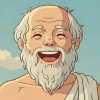
Do you see, Meno, what advances he has made in his power of recollection?
He did not know at first, and he does not know now, what is the side of a shape of 8 feet.
But then he thought that he knew, and answered confidently as if he knew, and had no difficulty. Now he has a difficulty, and neither knows nor fancies that he knows.
He is better off in knowing his ignorance.
If we have made him doubt, and given him the ’torpedo’s shock,’ then we would have assisted him in the discovery of the truth.
He will wish to remedy his ignorance.
But then he would have been ready to tell everyone again and again that the double space should have a double side.
But do you suppose that he would ever have enquired into or learned what he fancied that he knew, though he was really ignorant of it, until he had fallen into perplexity under the idea that he did not know, and had desired to know?

Then he was the better for the torpedo’s touch. Mark now the farther development. I shall only ask him, and not teach him. He shall share the enquiry with me.
Tell me if you find me telling or explaining anything to him, instead of eliciting his opinion.
I have drawn a square of 4 feet. Now I add another square equal to the former one. And a third, which is equal to either of them.

Let us fill up the vacant corner. There are now 4 equal spaces.
How many times larger is this space than this other?
But it should have been twice only, as you will remember.
This line reaching from corner to corner and bisects each of these spaces.
There are 4 equal lines which contain this space
Look and see how much this space is. Each interior line has cut off half of the 4 spaces
How many spaces are there in this section?
That is the line which the learned call the diagonal.
If this is the proper name, then you, affirm that the double space is the square of the diagonal?
Meno, all of his answers came out of his own head. And yet, he did not know.
But still he had in him those notions of his.
Then he who does not know may still have true notions of that which he does not know.
At present these notions have just been stirred up in him, as in a dream.
But if he were frequently asked the same questions, in different forms, he would know as well as any one at last?
Without any one teaching him he will recover his knowledge for himself, if he is only asked questions?
This spontaneous recovery of knowledge in him is recollection.
This knowledge which he has now, he always possessed.
But if he always possessed this knowledge he would always have known.
Or if he has acquired the knowledge he could not have acquired it in this life, unless he has been taught geometry;
He may be made to do the same with all geometry and every other branch of knowledge. Now, has any one ever taught him all this? You must know about him, if, as you say, he was born and bred in your house.
Yet he has the knowledge.
But if he did not acquire the knowledge in this life, then he must have had and learned it at some other time before he was born.
If there have been always true thoughts in him, both at the time when he was and was not a man, which only need to be awakened into knowledge by putting questions to him, his soul must have always possessed this knowledge, for he always either was or was not a man.
If the truth of all things always existed in the soul, then the soul is immortal. Wherefore be of good cheer, and try to recollect what you do not know, or rather what you do not remember.
I like what I am saying.
Some things I have said of which I am not altogether confident.
But that we shall be better and braver and less helpless if we think that we ought to enquire, than we should have been if we indulged in the idle fancy that there was no knowing and no use in seeking to know what we do not know;—that is a theme upon which I am ready to fight, in word and deed, to the utmost of my power.
Thus, a man should enquire about that which he does not know, shall you and I make an effort to enquire together into the nature of virtue?
Leave a Comment
Thank you for your comment!
It will appear after review.