
Menu
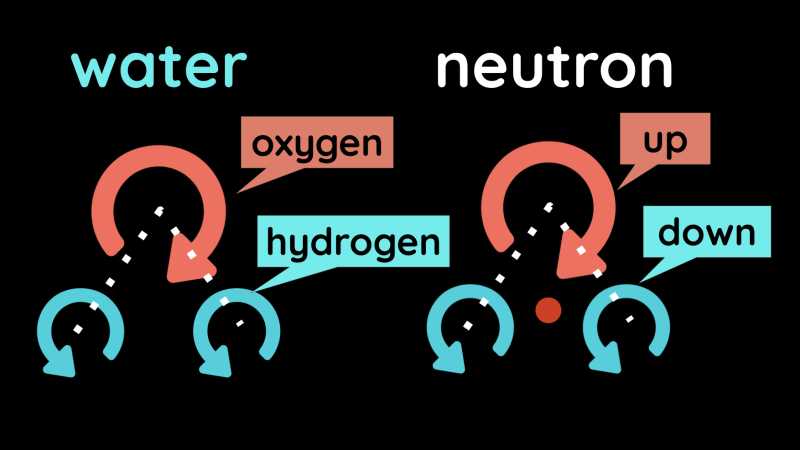
The inter-aetherspace flows around the molecules.
- Some flow in a clockwise direction.
- Others flow in an anticlockwise direction.
We call a bond that forms between opposing spins as contrarotational bond that forms between contrarotational molecules, which physics calls polar molecules.
Physics calls these Dipole-Dipole Forces.
Due to differences in flow direction, the entire molecules are attracted or repelled by each other.
Key Characteristics
- Strength: Moderate (5–50 kJ/mol)
- Range: Short to moderate
- Present in: Contrarotational (polar) molecules only
- Temperature dependence: Stronger at lower temperatures
A molecule is contrarotational if:
- It contains contrarotational bonds (opposing spins)
- The molecular geometry does NOT cause the contrarotations to cancel
Examples of Contrarotational Molecules:
| Molecule | Structure | Dipole Direction | Boiling Point (°C) |
|---|---|---|---|
| v1v17 (HCl) | Linear | v1⁺–v17⁻ | −85 |
| Water (H₂O) | Bent (104.5°) | Net rotation toward O | 100 |
| v7v1₃ (NH₃) | Trigonal pyramidal | Net rotation toward v7 | −33 |
Comparing Contrarotational vs. Same-spin (at Similar Mass)
| Substance | Formula | Molar Mass (g/mol) | Rotation | Boiling Point (°C) | Dominant Force |
|---|---|---|---|---|---|
| Propane | C₃H₈ | 44 | Same | −42 | Dispersion |
| Acetaldehyde | C₂H₄O | 44 | Contrary | 20 | contrarotational |
The contrarotational molecule boils 62°C higher due to contrarotational forces.
Real-World Importance:
- Solubility: Contrarotational substances (like sugar) dissolve in contrarotational solvents (like water) due to contrarotational interactions.
- Boiling points: Contrarotational molecules have higher boiling points than same-spin molecules of similar size.
- Biological recognition: Contrarotational interactions help enzymes recognize their target molecules.
Hydrogen Bonding
Hydrogen bonding is a special, unusually strong type of middle inter-aetherspace interaction.
It occurs when a hydrogen atom is covalently bonded to strongly feminine small atom, specifically v7 (nitrogen), v8 (oxygen), or v9 (fluorine).
This creates a very large female void on v1 (hydrogen) which then attracts the masculine pairs on v7, v8, or v9.
The males are then pulled away leaving an almost “naked” female v1.
This proton is strongly attracted to lone pair electrons on a nearby electronegative atom. –>
Key Characteristics
- Strength: Strongest intermolecular force (5–65 kJ/mol, about 10% of a covalent bond)
- Directional: Prefers a linear arrangement (donor–H···acceptor)
- Present in: Molecules with N–H, O–H, or F–H bonds
- Range: Very short (≈1.8 Å between H and acceptor)
Essential Conditions:
- Hydrogen bonded to N, O, or F only
- Lone pair electrons on a neighboring N, O, or F
Examples of Hydrogen-Bonded Compounds:
| Substance | Formula | Hydrogen Bond Type | Boiling Point (°C) | Without H-bonding (estimated) |
|---|---|---|---|---|
| Water | H₂O | O–H···O | 100 | −80 |
| Ammonia | NH₃ | N–H···N | −33 | −130 |
| Hydrogen fluoride | HF | F–H···F | 20 | −90 |
| Ethanol | C₂H₅OH | O–H···O | 78 | ≈0 |
Hydrogen Bonding in Water (Each water molecule forms up to 4 H-bonds):
      H
      |
H-O···H-O
|        |
H-O···H-O
      |
      H
Real-World Importance:
| Area | Role of Hydrogen Bonding |
|---|---|
| DNA structure | H-bonds between base pairs (A–T, G–C) hold the double helix together |
| Protein folding | H-bonds stabilize α-helices and β-sheets |
| Water’s properties | High boiling point, surface tension, ice floating, specific heat capacity |
| Cell membranes | H-bonds between water and polar head groups of lipids |
| Antifreeze proteins | Proteins use H-bonds to bind to ice crystals and prevent growth |
Why Ice Floats:
In liquid water, H-bonds constantly break and reform. In ice, water molecules form a rigid, open hexagonal lattice held together by H-bonds. This structure is less dense than liquid water, causing ice to float.
Leave a Comment
Thank you for your comment!
It will appear after review.