
Menu
The Hubble Tension is the difference in the measured expansion speed of the universe.
- The heat measurement from the Cosmic Microwave Background show an expansion rate of about 67 km/s/Mpc
- The light measurement from the redshift of nearby galaxies and Type Ia supernovae yield a faster rate of roughly 73 km/s/Mpc
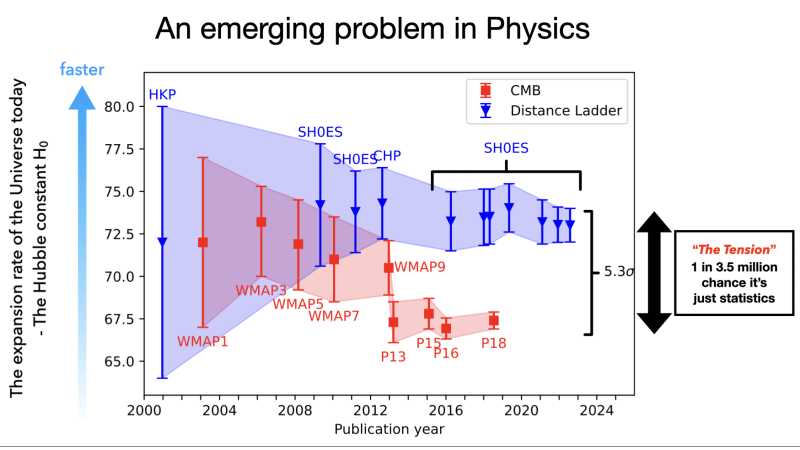
This is a proof of the difference in heat particles and light particles
- Heat particles have a shorter range and so its expansion is normal
- Light particles have a longer range and so its expansion is faster as it has to cover a larger distance in the same amount of time
We can say that:
- the density of heat-bearing space is higher than light-bearing space.
- the density difference then is caused by the displacement of the low density by the high density.
Leave a Comment
Thank you for your comment!
It will appear after review.